 Most reviewed
Guides
Language
EnglishCurrency
US dollar · $GetYourGuide shows prices in the currency you choose.
Guide · Neighborhood
Bo-Kaap: the colorful quarter where Cape Malay food began
The Bo-Kaap is small enough to walk in an hour and deep enough to fill a day: painted terraces, a 1768 house turned museum, mosques, and the kitchens of Cape Malay cooking.
Check availabilityfrom $49 · free to cancel
Editorial team, foodtourcapetown.comUpdated October 26, 2026Reading time about 6 minutes49 sources
Quick answer, for a first visit
A small quarter above the city
The Bo-Kaap sits on the slopes of Signal Hill, just above the grid of the city center, and you can feel the change the moment the streets tilt uphill. Iziko describes it as a small residential area, less than two kilometers long and less than half a kilometer at its widest point.8 It is a place to walk slowly, not to tick off. Come in the morning, when the light falls along the streets and the shops are opening, and give yourself time to stop for tea or a snack between the museum and the mosques.
The City of Cape Town calls the Bo-Kaap the earliest established Muslim community in South Africa and the city's oldest surviving residential neighborhood.1 Iziko says most of it was built between 1760 and 1840, and that it takes in four areas: the Malay Quarter, Stadzicht, Schotsche Kloof and Schoone Kloof.910
For a food lover, that history is the point. South African Tourism calls the Bo-Kaap the heart of traditional Cape Malay cuisine, and says it is still home to many of that cuisine's most authentic restaurants.611 Several food walks in Cape Town start here, and the tour this site books spends its first hour tasting in these streets.
History in dates
From the first arrivals to protection
-
From 1658
First arrivals
Slaves, exiles and convicts from East Africa and South East Asia.12
-
1760 to 1840
The streets are built
Most of the quarter goes up in these decades.9
-
1834
Emancipation
Many freed slaves move into the new parts of the Bo-Kaap.13
-
1950
Group Areas Act
The area is declared a residential area for Cape Muslims only.14
-
1978
The museum opens
Officially opened on 22 April.15
-
2019
Heritage protection
The City approves a heritage overlay zone.16
How the quarter came to be
The story begins with forced arrivals. Iziko says the ancestors of most Cape Muslims came from 1658 onwards as slaves, political exiles and convicts from East Africa and South East Asia, from India, Indonesia and Sri Lanka.12 Many of their descendants would make this hillside their home.
After slavery ended in 1834, Iziko says, many freed slaves moved into the new parts of the Bo-Kaap, taking over houses from the immigrants who were moving to the suburbs.13 Under apartheid, the area was declared an exclusively residential area for Cape Muslims under the Group Areas Act of 1950, and people of other religions were forced to leave.14
Today the neighborhood is protected. On 28 March 2019 the City announced that its council had approved a heritage protection overlay zone for the Bo-Kaap, after 2,271 of 2,298 public comments supported it, and over 600 private properties fall under it.1617 The national heritage agency has also given notice that it intends to declare a number of sites here National Heritage Sites.18
Reviews
Bo-Kaap experiences by number of reviews
reviews
Plan your visit
Ways to see the Bo-Kaap
| Option | Time | Bo-Kaap focus | Price |
|---|---|---|---|
| Museum visit | As long as you like | Social history | R100 international adult |
| Malay cooking class | 2.5 hrs | Cooking & lunch | from $49 |
| Food walk | 4 hrs | First hour here | from $141 |
| Walk & cooking class | 4 hrs | Walk & class | from $67 |
| City walk | 2 hrs | Last 15 min here | from $40 |
Museum fee as Iziko lists it; tour prices are each listing's starting price per guest, not a quote.19
Three ways in
Look, taste or cook
Most reviewed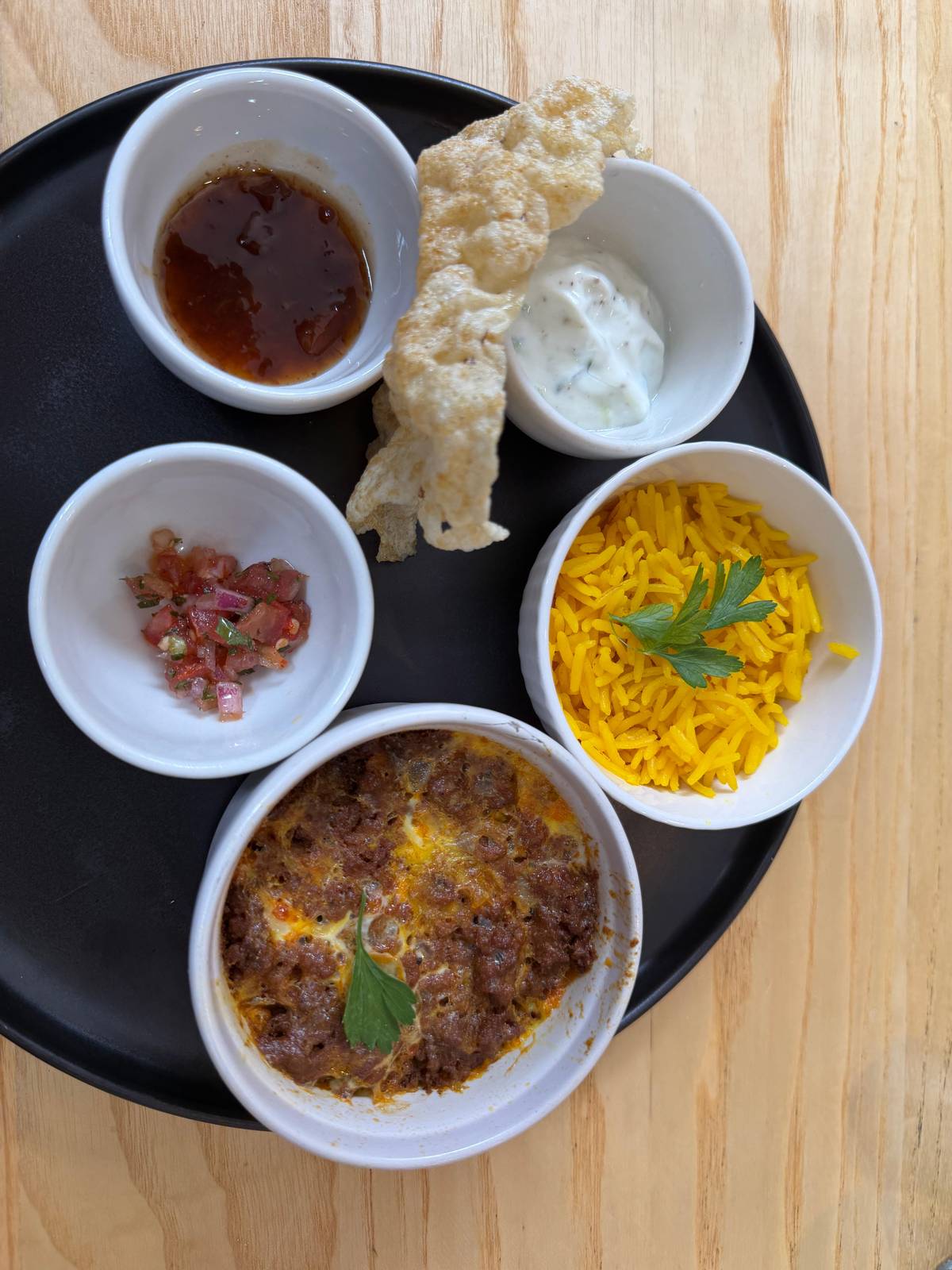 This site's pick
 Shortest
Decision helper
How do you want to spend your Bo-Kaap hours?
Start from what you want out of the visit.
The museum
A 1768 house that tells the community's story.20
The cooking class
2.5 hours with lunch, from a house on Wale Street.
The food walk
An hour here, then three more areas and 10+ tastings.
A city walk
2 hours across the center, ending in the Bo-Kaap.
A local restaurant
Many of the most authentic Cape Malay kitchens are here.11
Apart from being the earliest established Muslim community in South Africa, the Bo-Kaap is also Cape Town’s oldest surviving residential neighbourhood with well-presented, coherent streetscapes.
The colorful houses, and the people inside them
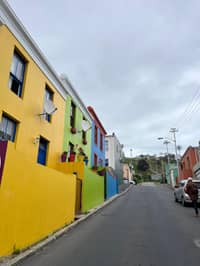
The colorful houses of the Bo-Kaap are the first thing you notice. The City calls these bright terraces huurhuise, houses where boundary walls are mostly absent and neighbors still mingle in the street.21 Iziko adds that the single and double-storey houses show Cape Dutch and Georgian influences, and that sharp corners, steep slopes and cobbles slow the traffic.22
South African Tourism says many of the buildings are well over 150 years old and were home to freed slaves and artisans from Malaysia, Indonesia, Sri Lanka and the islands of the Indian Ocean.23 Walk up Wale Street and down the side streets rather than standing on one famous corner; the quieter blocks are just as bright.
Remember that these are homes. Keep doorways and stoeps clear, ask before you photograph a person, and keep your voice down near the mosques at prayer time. The best pictures here tend to come from patience rather than a tripod in the middle of the road. If someone is sitting on their stoep, a greeting goes a long way, and it often leads to a tip about where to eat that no guidebook carries.
Map
Where to eat: the Bo-Kaap, the city, the coast and the vines
First the streets around the Bo-Kaap where the food walks begin, then the markets and neighbourhoods around the city, then the wine towns inland.
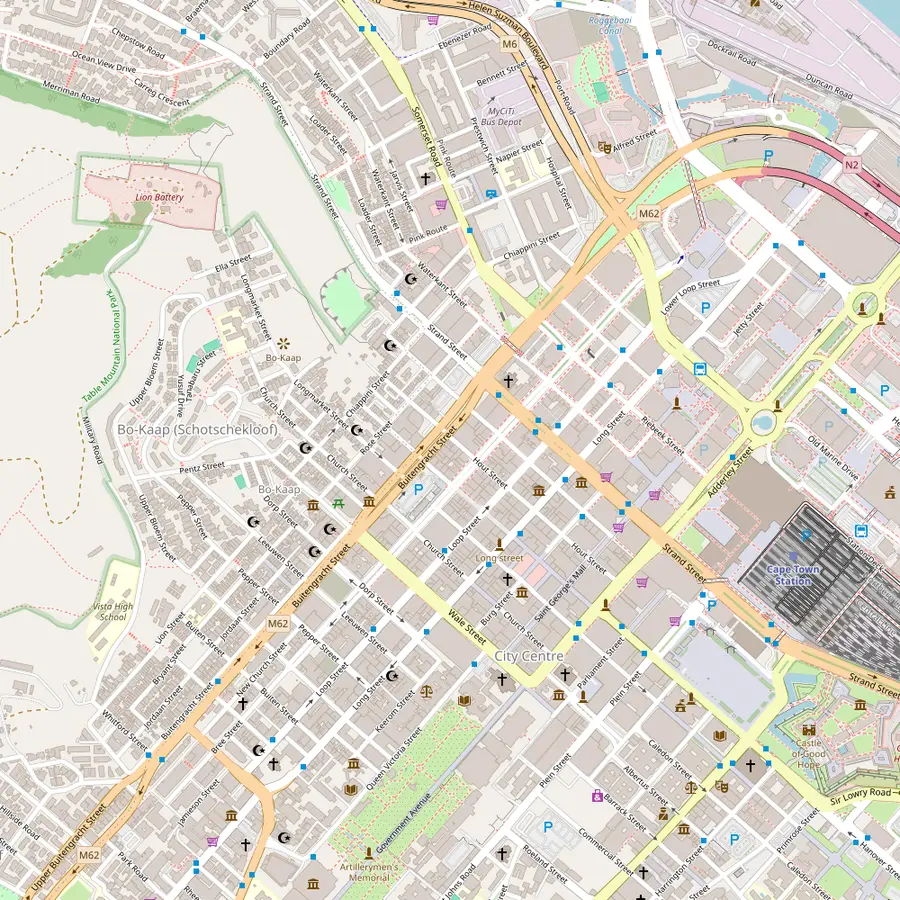 1Bo-Kaap Museum2Auwal Mosque3Greenmarket Square4Church Square5De Waterkant
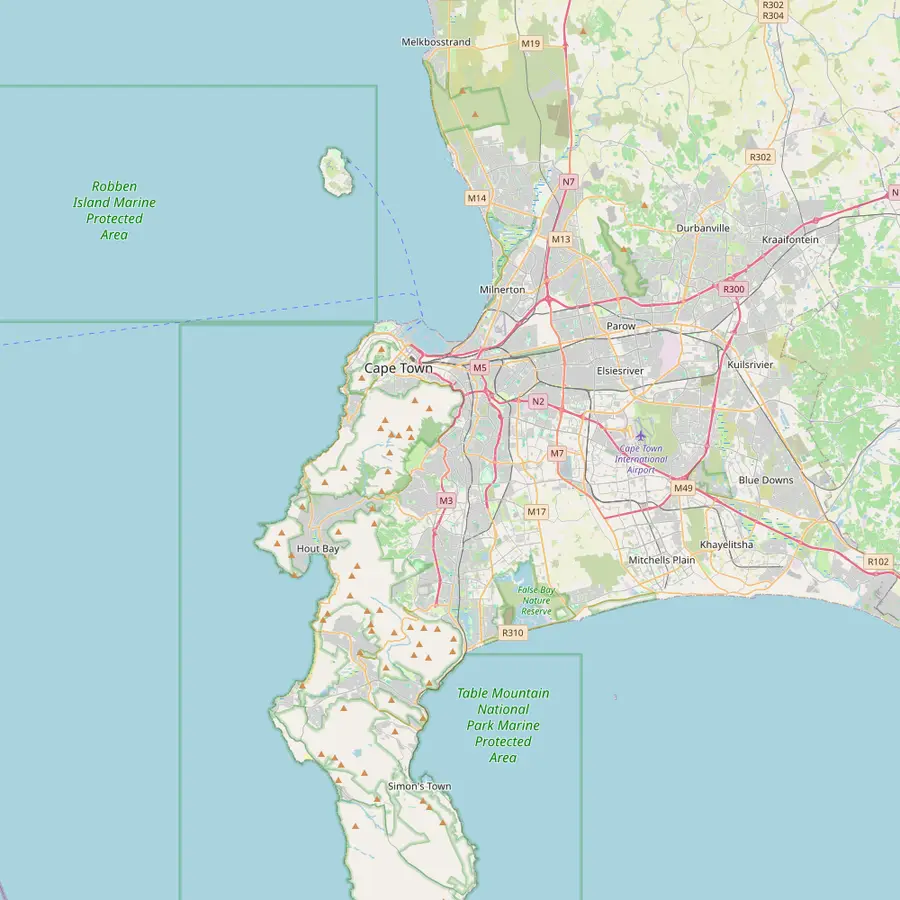 6V&A Waterfront7Old Biscuit Mill8Camps Bay9Bay Harbour Market10Gugulethu11Groot Constantia
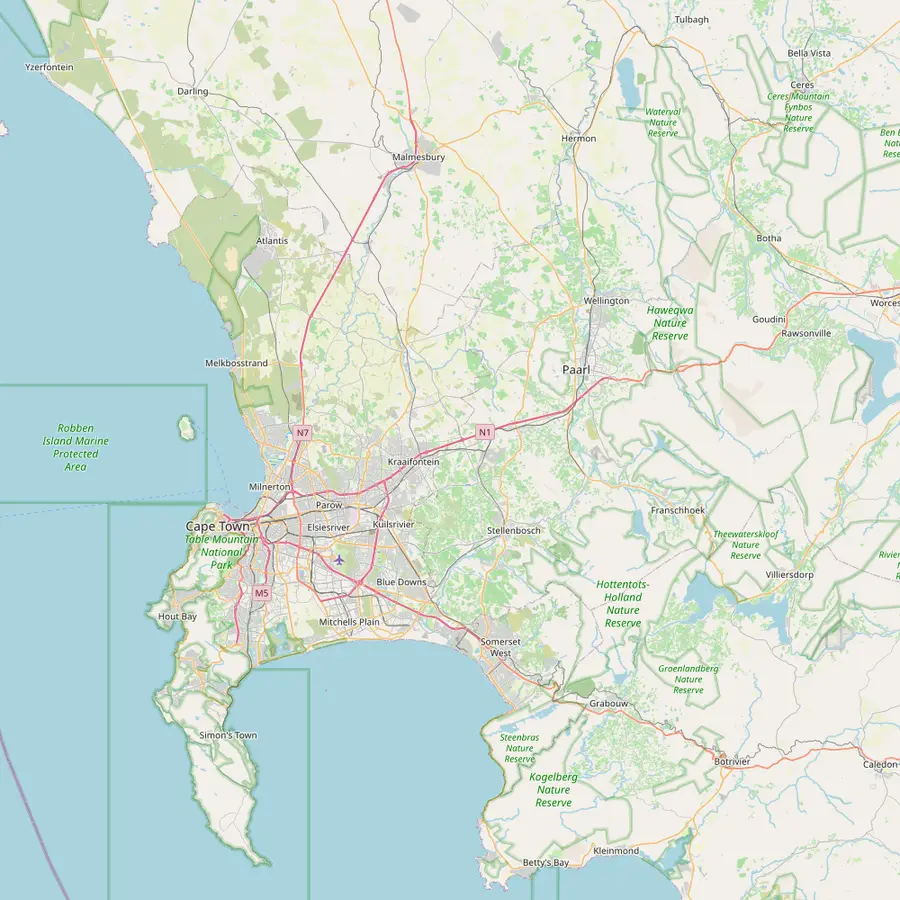 12Cape Town13Stellenbosch14Franschhoek15Paarl
- 1Bo-Kaap Museum
A 1768 house at 71 Wale Street, open 09:00 to 17:00 from Monday to Saturday.2032
In Google Maps ↗ - 2Auwal Mosque
South African Tourism calls it the oldest mosque in the country; dress modestly to go in.247
In Google Maps ↗ - 3Greenmarket Square
Several of the city food walks compared on this site pass through this square.
In Google Maps ↗ - 4Church Square
The African food and storytelling walk meets at the statue on this square.
In Google Maps ↗ - 5De Waterkant
The booked food tour spends its third hour here, and the 12 pm and 1 pm tours from Tuesday to Saturday end at a pub in the area.
In Google Maps ↗ - 6V&A Waterfront
Time Out Market, 13 kitchens, and the Oranjezicht City Farm Market at weekends.2526
In Google Maps ↗ - 7Old Biscuit Mill
Neighbourgoods Market every Saturday and Sunday from 9am, at 373-375 Albert Road in Woodstock.2728
In Google Maps ↗ - 8Camps Bay
Sidewalk restaurants and cafes line Victoria Road across from the beach.2930
In Google Maps ↗ - 9Bay Harbour Market
Hout Bay's weekend market at 31 Harbour Road, open on Friday evenings too.31
In Google Maps ↗ - 10Gugulethu
Mzoli's, where you choose your meat at the butcher before it is grilled.32
In Google Maps ↗ - 11Groot Constantia
Called the first wine farm in South Africa by South African Tourism.33
In Google Maps ↗ - 12Cape Town
Both full food and wine days compared here collect you in the city.
In Google Maps ↗ - 13Stellenbosch
A 45-minute drive from Cape Town, with more than 170 wine farms.34
In Google Maps ↗ - 14Franschhoek
French Huguenots settled mainly in this valley from 1688; its name means French quarter.3536
In Google Maps ↗ - 15Paarl
Fairview here is recommended for cheese and wine pairings.37
In Google Maps ↗
Checklist
Before you walk up Wale Street
01
Bring
- Comfortable shoes for steep, cobbled streets
- Clothes covering shoulders and knees for a mosque
- Small notes for street snacks
02
Plan around
- Museum hours, Monday to Saturday
- Ramadan, when restaurant hours may change
- Residents: ask before photographing people
- No alcohol at halaal restaurants
Price check
What a Bo-Kaap experience costs your group
Choose an option and the number of guests.
People
Total from$97
from, per person $49
Check availabilityfree cancellationEvery line takes the cheapest fare per guest that Viator or GetYourGuide shows for that trip, times your number of guests, converted with the European Central Bank's reference rate. The seller's own checkout shows the exact total.
Video
Walking and eating through the Bo-Kaap
Until you tap play, the video stays unloaded.
Inside the museum on Wale Street
The museum stands at 71 Wale Street in a house that Iziko dates to 1768, the only house built by the early developer Jan de Waal that keeps its original form.320 It was officially opened as a museum on 22 April 1978.15
Iziko runs it as a social history museum, and the stories it tells reach well beyond architecture: the slave origins of the community, the mosques and madrassas, the New Year Carnival that Iziko says officially started in 1907, with its parade on Tweede Nuwe Jaar, 2 January.3839 Its traditional route once wound up Wale Street.39
The museum opens from 09:00 to 17:00, Monday to Saturday, and closes on Christmas Day, Workers' Day and 1 to 2 January.240 Iziko lists the fee for international adults at R100 and for South African adults at R60.19 An hour inside gives you the context that makes the rest of the walk make sense.
Mosques, the cemetery and daily life
Iziko counts seven mosques in the Bo-Kaap today.41 South African Tourism says the Auwal Mosque, near the museum, is the oldest mosque in South Africa, and that the Tana Baru nearby is the country's oldest Muslim cemetery.24 Visitors who want to go inside a mosque are asked to dress modestly.7
Daily life still turns on small shops. Iziko says most retail outlets in the Bo-Kaap are family businesses passed down the generations, naming Biesmiellah Café, Rose Corner Café, Atlas Trading Centre and Rocksole, and that corner shops double as meeting places.4243 Cooking, like tailoring, was handed down the same way.43
Iziko calls food a key marker of identity here, tied to daily life, religious festivals, rites of passage and celebrations, with Ramadan and Eid among the traditions kept in the community.44 South African Tourism notes that Ramadan may affect restaurant trading hours, so check ahead if you visit then.45
Where to eat: Bo-Kaap restaurants and street snacks
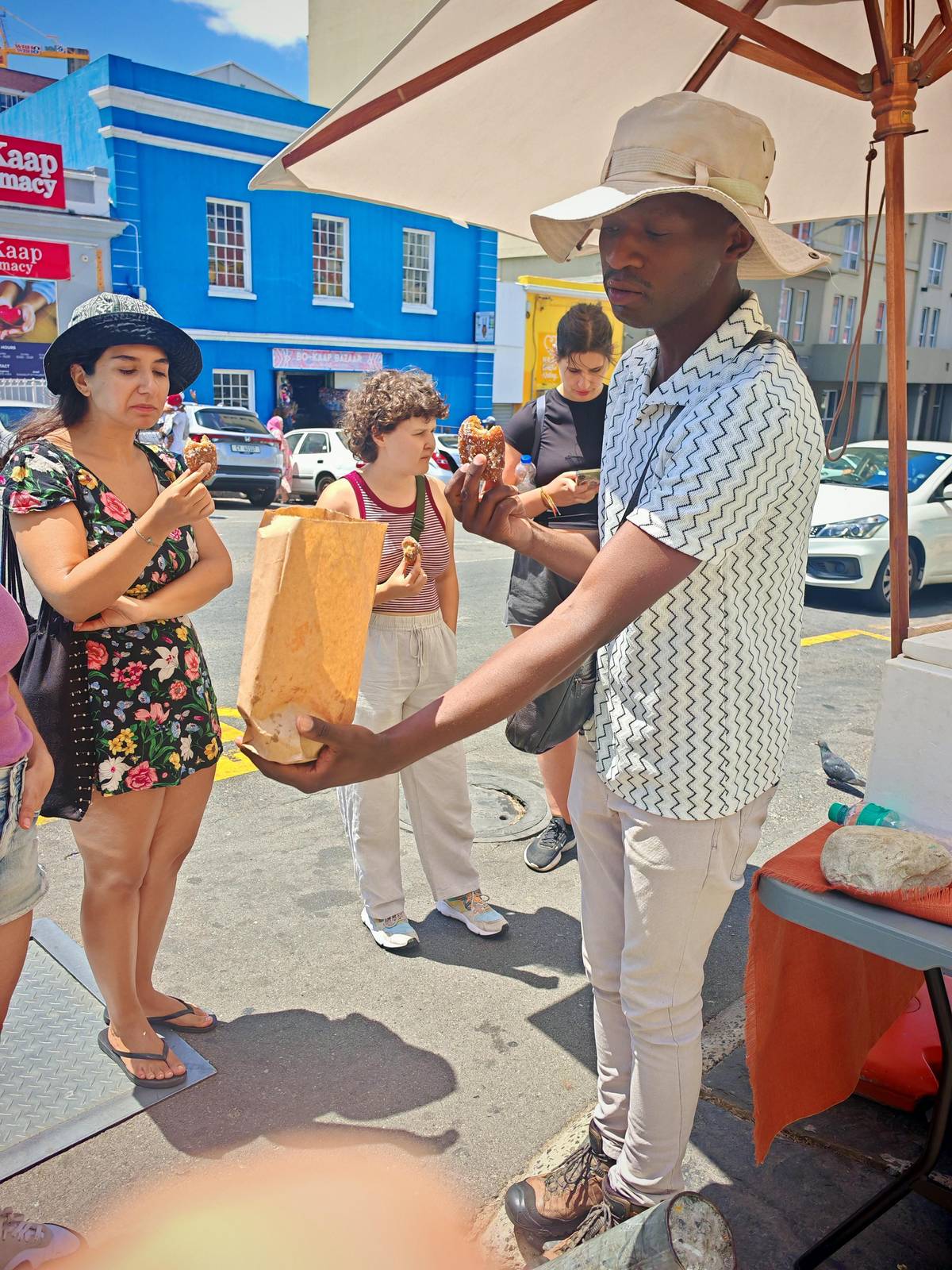
Bo-Kaap restaurants serve the dishes the community is known for. South African Tourism suggests a bredie, vegetables and meat stewed for a long time, at Biesmiellah, and names Bo-Kaap Kombuis for its platters of small savory bites, with the chilli sauce for sale to take home.44647
Almost all Cape Malay restaurants in the city are strictly halaal, so no alcohol is allowed on the premises.48 Look out too for the tables locals set up on the sidewalk, which South African Tourism says sell small salt and pepper steak pies and koeksisters made fresh and served hot.49
If you want to understand the food rather than just eat it, join a guide. The tour this site books spends its first hour tasting and exploring here, and a Malay cooking class with lunch runs from a house on Wale Street. Our page on the Bo-Kaap cooking class compares the options.
How to see it: on foot, with a guide, or at a stove
The simplest way is on foot, on your own, from the museum. Combine an hour inside with a slow loop of the streets and a late lunch, and wear comfortable shoes, because the slopes are steep.7
A guided walk adds the stories. A 2-hour city walk on GetYourGuide crosses the center and finishes with 15 minutes in the Bo-Kaap, from $40. A 4-hour walk with a Malay cooking class spends far longer here, from $67.
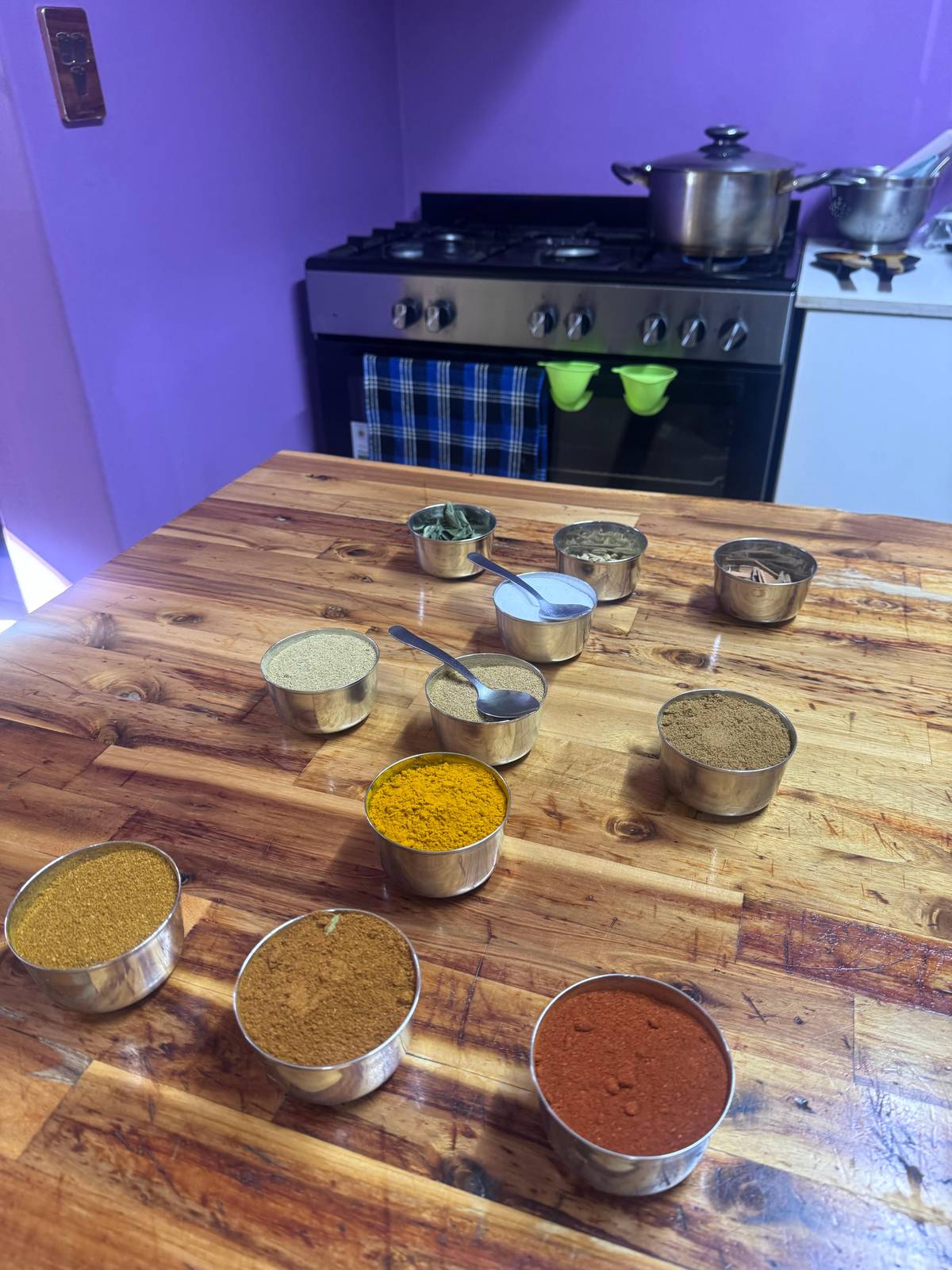
The class with the most reviews is the 2.5-hour Malay cooking class with lunch from 109 Wale Street, 626 reviews and a rating of 4.82, from $49. You cook, then sit down to eat what you made, which is as close as a visitor gets to a Bo-Kaap family table. Whichever way you choose, end the day with a plate of something slow-cooked and a sweet koeksister, and the hill will make sense in a way a photo never quite manages.
Book your afternoon
Four neighborhoods, one long tasting lunch.
Up to 12 guests, 10+ tastings with drinks, and a full refund up to 24 hours ahead.


You ask,we answer.
What is the Bo-Kaap known for?
Its painted houses and Cape Malay food. The City calls it Cape Town's oldest surviving residential neighborhood and the earliest Muslim community in South Africa.16
When is the museum open?
Monday to Saturday, 09:00 to 17:00. It closes on Christmas Day, Workers' Day and 1 to 2 January.240
How much does the museum cost?
R100 for international adults. Iziko lists R60 for South African adults; prices are as the museum states them.19
How big is the neighborhood?
Small enough to walk. Iziko says it is less than two kilometers long and less than half a kilometer at its widest.8
Can I drink alcohol at restaurants there?
Usually not. Almost all Cape Malay restaurants are strictly halaal, so no alcohol is allowed on the premises.48
What should I wear?
Comfortable shoes, and modest clothes for mosques. South African Tourism asks visitors to dress modestly if they go into a mosque.7
Sources
Sources and evidence
- 1City of Cape TownCity Council approves heritage protection for Bo-Kaap↩
- 2Iziko Museums of South AfricaBo-Kaap Museum↩
- 3Iziko Museums of South AfricaBo-Kaap Museum↩
- 4South African TourismCape Malay cuisine: food that feeds the soul↩
- 5South African TourismIconic South African foods: taste all the flavours of the Rainbow Nation↩
- 6South African TourismThe Bo-Kaap Museum↩
- 7South African TourismThe Bo-Kaap Museum↩
- 8Iziko Museums of South AfricaBo-Kaap Museum↩
- 9Iziko Museums of South AfricaBo-Kaap Museum↩
- 10Iziko Museums of South AfricaBo-Kaap Museum↩
- 11South African TourismEating out in Cape Town: fine dining and Cape cuisine↩
- 12Iziko Museums of South AfricaBo-Kaap Museum↩
- 13Iziko Museums of South AfricaBo-Kaap Museum↩
- 14Iziko Museums of South AfricaBo-Kaap Museum↩
- 15Iziko Museums of South AfricaBo-Kaap Museum↩
- 16City of Cape TownCity Council approves heritage protection for Bo-Kaap↩
- 17City of Cape TownCity Council approves heritage protection for Bo-Kaap↩
- 18South African Heritage Resources AgencyNotice - Bo-Kaap Declaration↩
- 19Iziko Museums of South AfricaBo-Kaap Museum↩
- 20Iziko Museums of South AfricaBo-Kaap Museum↩
- 21City of Cape TownCity Council approves heritage protection for Bo-Kaap↩
- 22Iziko Museums of South AfricaBo-Kaap Museum↩
- 23South African TourismSpice up your holiday with a Cape Malay cooking safari↩
- 24South African TourismThe Bo-Kaap Museum↩
- 25Time Out Market Cape TownFAQs: Time Out Market Cape Town↩
- 26Oranjezicht City Farm MarketThe Oranjezicht City Farm & Market↩
- 27The Old Biscuit MillNeighbourgoods Market↩
- 28The Old Biscuit MillNeighbourgoods Market↩
- 29City of Cape TownCamps Bay Beach↩
- 30↩
- 31The Bay Harbour MarketThe Bay Harbour Market, Hout Bay↩
- 32South African TourismShisa nyama: the vibe, the food, the spirit↩
- 33South African TourismCape Winelands↩
- 34South African TourismCape Winelands↩
- 35Wines of South AfricaHistory: Three Centuries Timeline↩
- 36South African TourismCape Winelands↩
- 37South African TourismCape Winelands↩
- 38Iziko Museums of South AfricaBo-Kaap Museum↩
- 39Iziko Museums of South AfricaBo-Kaap Museum↩
- 40Iziko Museums of South AfricaBo-Kaap Museum↩
- 41Iziko Museums of South AfricaBo-Kaap Museum↩
- 42Iziko Museums of South AfricaBo-Kaap Museum↩
- 43Iziko Museums of South AfricaBo-Kaap Museum↩
- 44Iziko Museums of South AfricaBo-Kaap Museum↩
- 45South African TourismThe Bo-Kaap Museum↩
- 46South African TourismCape Malay cuisine: food that feeds the soul↩
- 47South African TourismCape Malay cuisine: food that feeds the soul↩
- 48South African TourismEating out in Cape Town: fine dining and Cape cuisine↩
- 49South African TourismCape Malay cuisine: food that feeds the soul↩
Keep reading
More guides to eating in Cape Town
 Cape Town culinary tours compared: walking food tours, private tastings and African food walks
 Best restaurants in Cape Town: the 2026 award list by neighbourhood
Cape Malay cooking class in the Bo-Kaap: what you cook, how long, and which class
 Cape Town food: the dishes to try and where they come from